
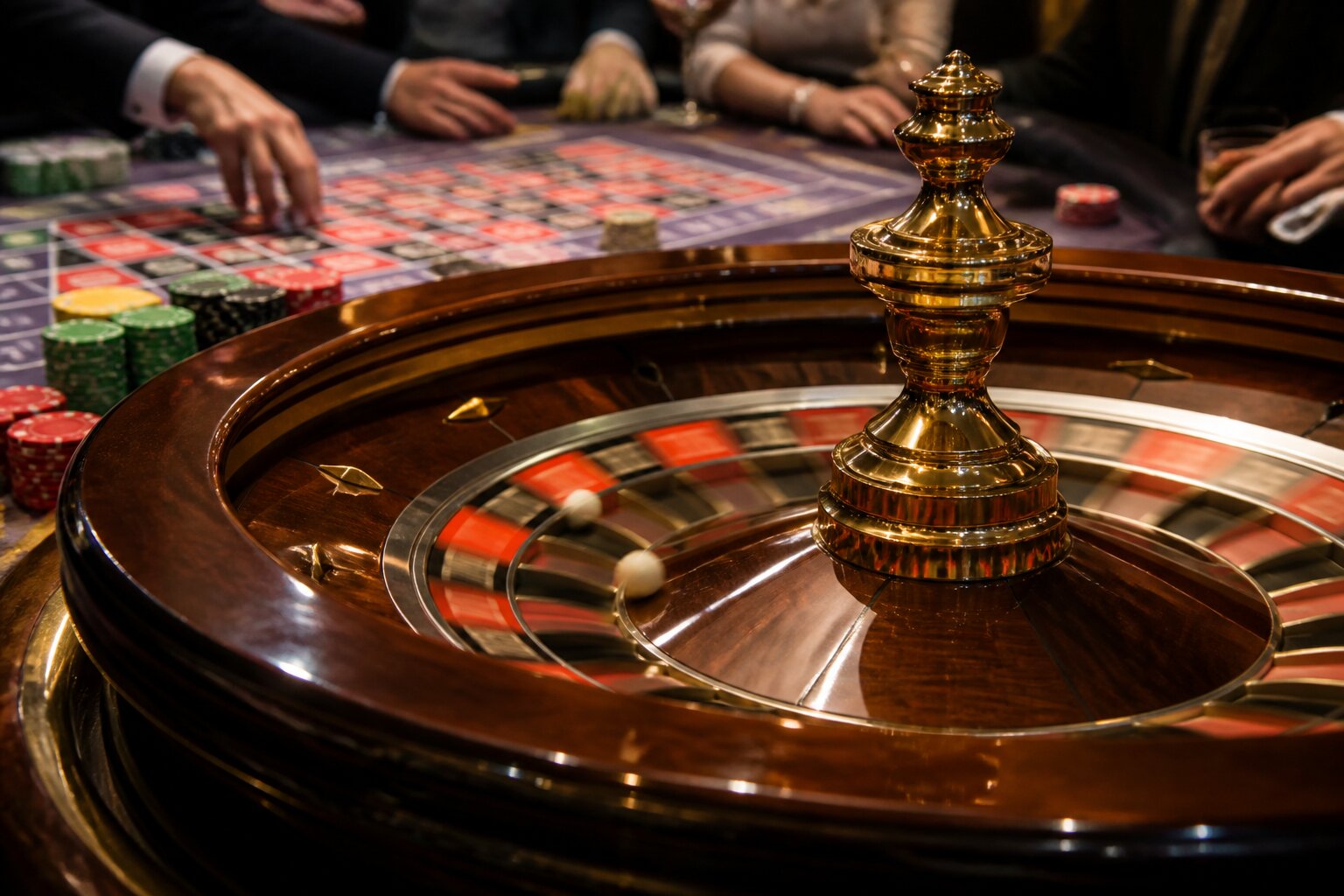
Have you ever tried to work out why the casino seems to come out ahead at roulette, even when players win quite a lot in the short term? The explanation is straightforward: the game’s rules include a built-in advantage for the house that turns small differences in payout into long-term profit.
This article breaks down the maths behind roulette, explains how the house edge changes between wheel types, and shows how payouts compare with true probabilities. Read on to see how those green pockets quietly shape the odds and what that means for play.
What Is the House Edge in Roulette?
The house edge is the percentage advantage the casino has on every bet. It comes from the way payouts are set compared with the actual probabilities of each outcome. Over many spins the difference between true odds and payout rates converts into a steady return for the casino.
On a European wheel, which has one zero, the house edge is about 2.7%. That means that across a large number of bets, roughly £2.70 of every £100 wagered is retained by the house on average. On an American wheel with both a zero and a double zero the edge rises to about 5.26%, so the house’s expected take is higher over time.
These percentages are not guarantees for any single session. Instead they describe the average result over large numbers of plays, which is why wheel design matters so much for the long-term maths.
How Are Roulette Bets Structured?
Roulette betting is organised around where the ball lands after a spin. Players can place chips on individual numbers, on colours, on odd or even, or on groups of numbers such as rows or corners. Each type of bet carries a fixed payout—for example, a correct single-number bet is paid at 35 to 1, while a correct red or black bet pays even money.
The key point is that each payout corresponds to a stated return but does not match the actual probability of that outcome. That mismatch is the source of the house edge. Bets that seem fair at first glance are calibrated so the casino’s expected return is positive across many spins.
If you want to compare bet types, look at how often an outcome must occur to make a bet fair and then compare that to the payout. That comparison directly reveals how much the house keeps on average.
Why Does the House Edge Differ Between American and European Roulette?
The difference between the two main wheel types is the number of green pockets. European wheels have one zero, while American wheels include both a zero and a double zero. Each extra green pocket increases the number of possible outcomes without increasing payouts, so the house edge rises.
In practice this means the American wheel pays the same fixed amounts as the European wheel for identical bets, but the chance of winning any given bet is slightly lower on the American wheel. The result is a higher expected return for the casino on American wheels compared with European ones.
This simple design change is why many players prefer European layouts when they are available, since the lower house edge reduces the casino’s expected take over time.
How Do Payouts Compare to Actual Odds?
Payouts are set numbers, such as 35 to 1 for a straight-up number, but the probability of that outcome is determined by the count of pockets on the wheel. On a European wheel the chance of hitting one chosen number is 1 in 37; on an American wheel it is 1 in 38. Because the payout is less generous than the true reciprocal of those probabilities, every winning payout leaves a small gap that favours the house.
This gap is the practical mechanism of the house edge. When many bets are resolved, those small differences accumulate into the casino’s expected profit. For players, that means the headline payouts look attractive but do not reflect the long-term statistical balance.
The Role of Zero on the Roulette Wheel
Zero is neither red nor black and is not counted as odd or even. Because of that special status, most common bets lose when the ball lands on zero. The presence of a zero or two zeros changes the balance between the number of winning outcomes and the payouts offered, and that is what creates the house advantage.
Casinos rely on those green pockets to keep the payout structure slightly unfavourable to bettors while maintaining predictable operation of the game. The difference is deliberately small so the game remains attractive and simple to play, but it is enough to produce a consistent profit margin for the house over the long term.
Single Zero vs Double Zero: What’s the Impact?
A single zero lowers the house edge compared with a wheel that includes a double zero. The extra green pocket on an American wheel increases the total number of outcomes but does not change payouts, so the relative probability of winning falls and the house edge increases.
In practical terms, this change means:
- more possible results on the wheel when a double zero is present,
- the same payout amounts despite the larger outcome set,
- a lower chance of any given bet winning, and
- a higher long-term expected advantage for the casino.
The mathematical effect is clear: a small change to wheel layout produces a measurable change to long-term expected return. Remember that roulette outcomes are random and the house edge determines expected results over many spins, not any single spin. Play for entertainment and within limits.
Do Casinos Ever Lose Money on Roulette?
Short-term swings can go against the house. A run of winning outcomes for players can lead to a net loss for the casino over some period. That variability is a normal feature of any game that resolves randomly.
What makes the business model robust is that the house edge applies to every bet. Over thousands or millions of bets those small percentages aggregate into a predictable profit margin. So while individual sessions can be unfavourable to the casino, the overall design ensures the expected result across many bets favours the house.
If you’re planning play, think in terms of sessions and variance rather than certain outcomes. Occasional substantial wins can happen, but they do not change the underlying statistical advantage the house holds.
Common Misconceptions About Casino Profits and Roulette
There are several persistent myths about beating roulette that are worth addressing.
- “Roulette systems can beat the house.” No betting pattern changes the fundamental maths. Systems that alter bet sizes do not change the probabilities of outcomes or the house edge.
- “Casinos always win every session.” The house edge describes an average across many bets, not a guarantee for every session. Casinos can and do lose over short periods.
- “Certain numbers are ‘due’ to come up.” Outcomes of separate spins are independent; past results do not influence future spins.
- “Big bets increase the chance of winning.” Wager size does not alter the probability of any outcome.
Understanding these points helps set realistic expectations about play and prevents common mistaken beliefs from shaping how people bet.
How Does the House Edge Ensure Long-Term Profit?
The house edge translates to steady profit because payouts are set below the true odds. Each resolved bet leaves a tiny expected shortfall for the player and a corresponding expected gain for the casino. When you multiply that small difference by the large quantities of bets placed in a casino environment, the totals become significant.
Over time the law of large numbers makes those expected values reliable; the more spins that occur, the closer the actual results tend to the statistical expectation. That is the practical reason operators can run roulette profitably: the rules create a slight but consistent advantage that accumulates.
That said, individual players will still experience wins and losses that depart from the average, sometimes by a wide margin. Keep wagers proportional to what you are prepared to lose, and treat play as entertainment rather than a strategy for income. If you want to try different tables, choose wheel types and bet mixes that align with how much variation you are comfortable accepting.
This explanation shows how a small edge in each bet becomes a dependable business model for the house while leaving room for short-term swings at the table.
**The information provided in this blog is intended for educational purposes and should not be construed as betting advice or a guarantee of success. Always gamble responsibly.