
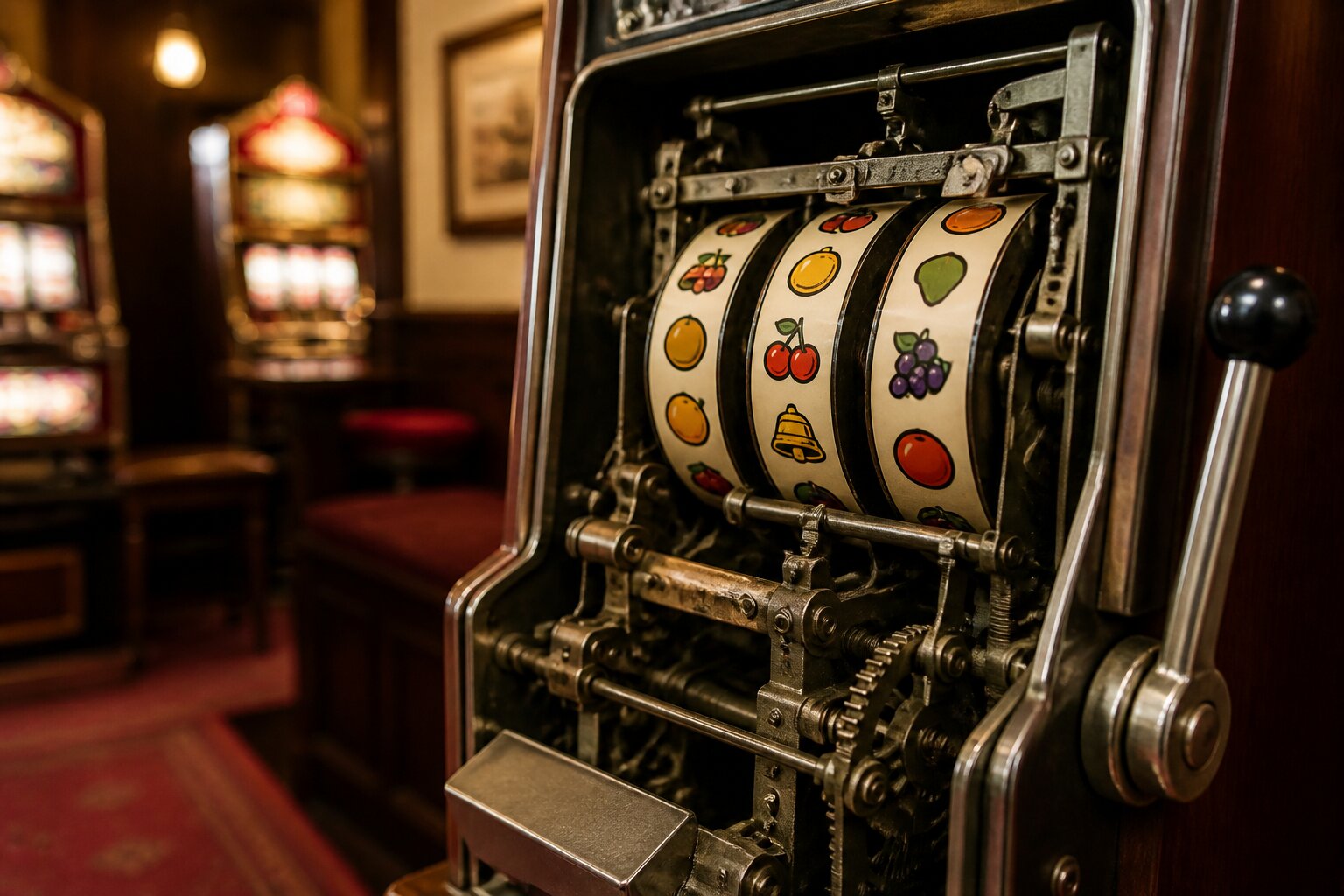
Ever wondered what goes on inside an old-school slot machine when you pull the lever? Those flashing lights and spinning reels hide a neat blend of engineering and design that kept players fascinated long before digital screens took over.
Step away from today’s electronic games for a moment and travel back to the heart of classic slot machines. These devices entertained people for well over a century by using only physical parts to generate outcomes, and their simplicity is part of their charm.
If you want to peek behind the cabinet and see how the mechanisms interact, this article will open the machine up for you and explain the key parts and processes in plain language. Read on to discover how those reels, gears and stoppers work together to create each result.
What Are Mechanical Slot Machines?
Mechanical slot machines are gambling devices driven entirely by physical mechanisms rather than computer software. They typically use three or more metal reels, each marked with a set of symbols. Pulling the lever engages a series of springs, gears and levers that make the reels spin and then stop, revealing a symbol combination.
What distinguishes these machines is their self-contained, tangible operation: there are no random number generators, no video screens, and no electronic memory of earlier plays. Outcomes arise from the way the components are arranged and interact during each pull. Play is straightforward—insert a coin or token, release the lever, watch the reels and hope the symbol alignment qualifies for a payout.
Mechanical machines were a familiar sight in land-based venues and arcades for many decades. They required regular maintenance to keep the moving parts in good order and were always intended for adult use in regulated settings. The next section looks at the main components and how they each contribute to the game working correctly.
Core Components of Classic Slot Machines
A classic mechanical slot machine contains a handful of essential parts that together produce the spinning, stopping and paying functions.
The reels are the visible elements most players recognise. Each is a cylindrical drum fixed to a shaft, marked with symbols in a specific order set by the manufacturer. The weight and balance of each reel are adjusted so they spin smoothly and settle reliably when engaged by the stopping mechanism.
The player-operated lever starts the sequence. Pulling it winds or releases a tensioned spring and transfers motion through gears and linkages that set the reels in motion. Inside the cabinet, a system of pulleys, cams and notched edges governs the reels’ speed and eventual arrest.
Kickers and spring-loaded stoppers control the precise moment a reel comes to rest. Kickers provide an initial impulse to spin, while stoppers engage with notches on the reel edge as the motion slows. Those interactions determine which symbol aligns with the payline.
Finally, the coin detection and payout mechanism manage the financial side: authenticating coins or tokens, unlocking the lever, and releasing coins into the tray when a win is registered. Together, these components make a self-contained mechanical cycle from payment through payout. The following section unpicks how that cycle, particularly the reeling system, actually operates in practice.
How Does the Mechanical Reeling Mechanism Operate?
At the core of every mechanical slot is the reeling mechanism, a coordinated assembly designed to produce random-looking results within the machine’s physical constraints. It’s engineered so each play is independent — the machine has no memory of prior spins and cannot adjust outcomes based on past events.
Physical Reels and Symbols
Each reel is a metal drum with symbols fixed in a predetermined order. Manufacturers decide how many symbols go on a reel and their sequence, which in turn affects how often particular combinations can occur. When the mechanism is activated, the reels rotate freely for a short period; their symbols blur and then resolve as the motion slows.
Because symbol frequency and placement are physically fixed, manufacturers can design a machine to have certain probabilities for specific combinations while still relying purely on mechanical action to produce each individual result.
The Role of the Kickers and Stoppers
Kickers are parts that give each reel its initial spin by engaging notches or teeth at the reel’s edge. As the rotation decelerates, spring-loaded stoppers move into place and latch into those notches. The exact geometry and timing of these elements determine which symbol lands on the payline.
This mechanical coordination creates the suspense of the spin and the unpredictability of the outcome. Although the system is entirely mechanical, careful engineering ensures consistent performance and that every play is a distinct event. With the mechanics in motion, the next question is how wins are identified and paid out.
How Are Wins Determined in Mechanical Slots?
Wins are determined purely by the symbols that line up on the payline when the reels stop. There is no skill involved; the machine’s internal parts deliver the result and switches behind the reels record their final positions.
When a coin is accepted, the coin mechanism verifies its size and physical properties and then enables the lever. After the reels stop, mechanical contacts or sensing devices behind the reel faces detect which symbols inhabit the payline positions. If those positions match a payout combination, an internal payout mechanism engages to release coins from a hopper to the collection tray.
Because the whole process is physical, randomness stems from the dynamics of moving parts rather than software. The outcome of each spin is an independent mechanical event governed by the machine’s configuration and the interaction of its components. With that in mind, it’s worth looking at some persistent misunderstandings about how these machines function.
Common Myths About Mechanical Slots
Several myths have circulated about mechanical slot machines, often suggesting patterns or tricks to influence outcomes. One persistent idea is that machines run in cycles that can be predicted; in truth, each spin is mechanically independent and the machine has no memory to create a pattern in the human sense.
Another misconception is that a player’s technique in pulling the lever can change the result. In mechanical designs the lever simply sets the mechanism in motion; the reels’ final positions are determined by the internal engagement of stoppers and gears, not by the player’s timing or force.
Claims that a machine can be “due” a win after a long dry spell misinterpret how mechanical randomness works. While manufacturers can design symbol distribution to create certain probabilities, nothing inherent in the mechanism guarantees a win after a set number of plays. Understanding these points helps separate fact from folklore and prepares the way to consider why mechanical slots fell out of common use.
The Decline of Mechanical Slot Machines
Mechanical slot machines gradually gave way to electronic alternatives as technology advanced. Electronic systems introduced features that were difficult or impossible to achieve with purely mechanical hardware: digital displays, more varied symbols and pay tables, complex bonus features, and more precise record-keeping.
Regulatory requirements also shifted in favour of electronic systems. Digital machines can offer enhanced monitoring, audit trails and configurable settings that assist operators in meeting compliance standards. They often require less frequent physical maintenance and can be updated more easily than mechanical devices.
The rise of internet-based gaming accelerated the change by making games accessible remotely, something mechanical cabinets cannot provide. As a result, mechanical machines are now largely retired from everyday gambling floors and are instead preserved in museums, private collections and specialist displays. That preservation brings us to the value these antiques can hold for collectors and historians.
Do Antique Slot Machines Have Collectible Value?
Antique slot machines are often prized for craftsmanship, period detail and mechanical ingenuity. Collectors look for machines with intact artwork, original parts and identifiable manufacturer markings. Certain early models, especially those from well-known makers or limited production runs, can command significant interest.
Beyond monetary value, these machines are sought as historical objects that illustrate the evolution of gaming technology. Restored examples demonstrate the engineering solutions of their era and can make attractive centrepieces in private collections or museum exhibits.
Potential buyers should be aware that laws around ownership and display vary, and most antique machines are not suitable for operational gambling use under current regulations. Those interested in acquiring a machine should take local rules into account and verify provenance and condition when assessing any item’s value. Next, we’ll consider where genuine mechanical machines can still be seen today.
Are Mechanical Slot Machines Still Used Anywhere?
True mechanical slots are rarely used in modern gambling venues. In many jurisdictions they no longer meet regulatory requirements for commercial play and have been superseded by electronic counterparts that offer better security and record-keeping.
You can still encounter mechanical machines in non-gaming contexts: museums, private collections, heritage exhibitions and specialist events that focus on the history of leisure and entertainment. Some venues restore machines for display so visitors can appreciate the engineering and artwork, though these are presented as historical pieces rather than functional gambling equipment.
Because ownership and display rules vary, institutions and collectors typically ensure compliance with local laws when exhibiting these machines. Their presence today is largely educational and decorative, serving as a tangible link to the early days of public gaming. The final section wraps up why these machines remain interesting despite their decline.
Summary: The Enduring Appeal of Classic Slot Mechanisms
Classic mechanical slot machines endure as objects of design and engineering interest. Their appeal lies in visible, working mechanisms: the reels, kickers, stoppers and coin systems that together produce each result without electronics. While modern games have moved to digital platforms for greater flexibility and regulatory ease, these machines remind us how early gaming relied on clever mechanical solutions.
For collectors and historians, mechanical slots are valued as artifacts that document a particular era of technology and leisure. And for anyone encountering one in a museum or collection, the machines offer a direct view of how physical components can produce complex outcomes. If you choose to play modern casino games, do so within your limits and treat gambling only as a form of entertainment.
**The information provided in this blog is intended for educational purposes and should not be construed as betting advice or a guarantee of success. Always gamble responsibly.