
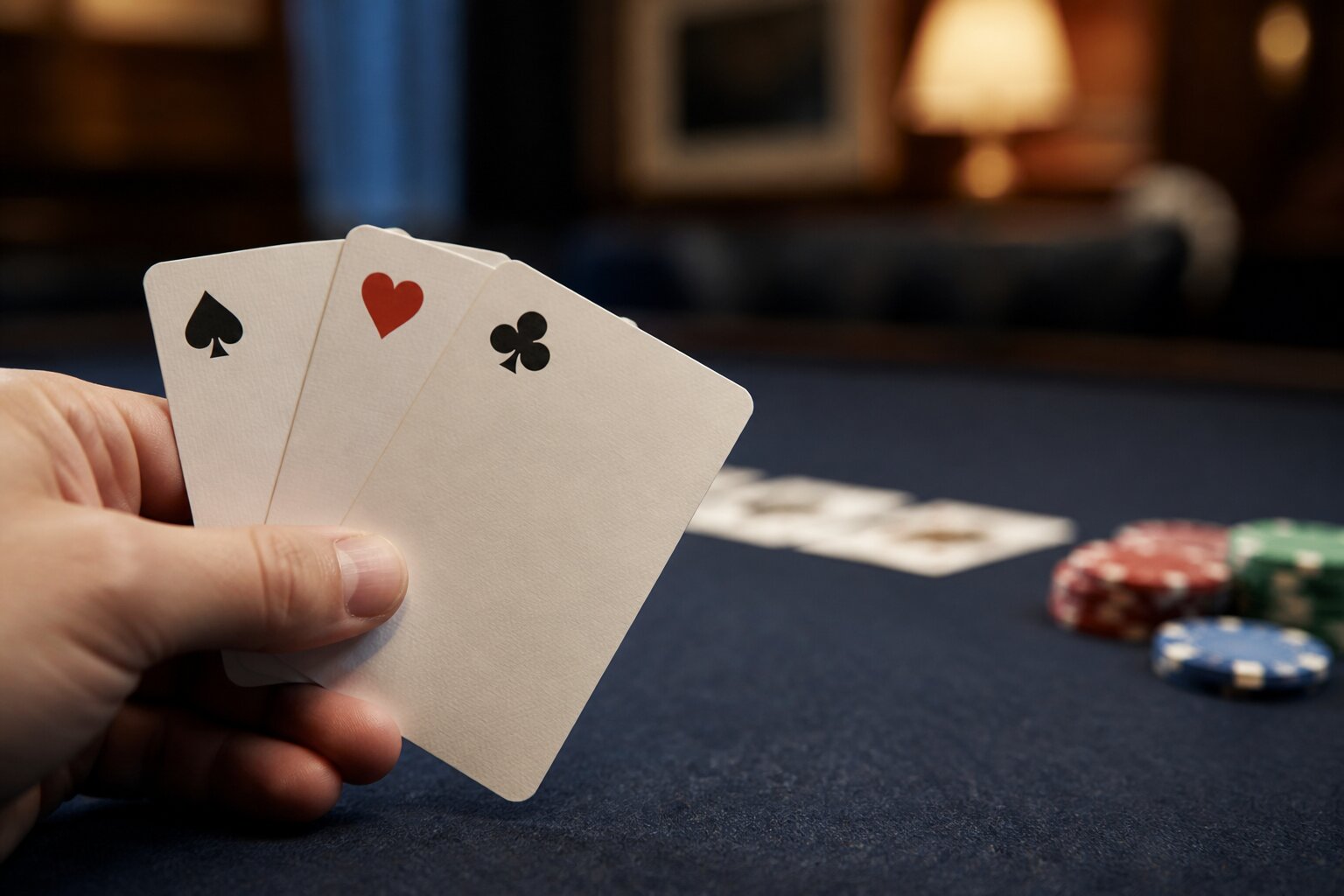
Fancy trying one of Britain’s oldest and most-loved card games? 3 Card Brag is a fast-paced favourite at family gatherings and in lively casinos, prized for quick rounds and easy-to-learn play.
Whether you’re completely new or want a clear refresher, learning how 3 Card Brag works will make the game more enjoyable. From reading your best hand to following the rules, each part of the game fits together in a straightforward way.
Keep reading to learn how the game runs, what beats what, and how different hands compare — all explained so you can get into the action with confidence.
What Is 3 Card Brag?
3 Card Brag is a traditional British card game with roots in the 18th century. Played with a standard 52-card deck, each player receives three cards and competes to hold the highest-ranking hand under a ranking system unique to the game. Rounds are brisk and decisions come quickly, which is why it’s popular in social settings and among players looking for a lively, short-format game.
The game’s distinct hand hierarchy and simple mechanics have kept it popular for generations. Outcomes are determined by how the cards fall and by the betting choices players make during each round, so understanding both the hand rankings and the betting structure is useful. Next, we’ll look at how a typical round of play unfolds.
How Do You Play 3 Card Brag?
Play begins with every participant contributing an agreed stake into the pot. The dealer deals three cards, face down, to each player. Everyone inspects their own cards privately and then the betting starts.
On their turn a player can match the current bet, increase it, or fold and leave the round. When only two players remain, one may request a “see”, prompting both to reveal their hands and compare them; the higher-ranking hand wins the pot. If all other players fold, the last player standing claims the pot without showing cards.
Rounds are compact: there are no card swaps or draws, and each hand is resolved quickly. Understanding the flow of decisions during betting helps you feel more comfortable at the table and prepares you for the hand-ranking rules that decide the winner.
Game Setup & Dealing
A fair, well-run game starts before any cards are touched. Players agree the size of the initial stake, or ante, which sets the pot for that round. The dealer position can be fixed or rotate clockwise so everyone takes turns dealing.
The dealer shuffles thoroughly and deals three cards to each player, face down. Players keep their cards hidden; revealing them prematurely can shift the mood and affect how others play. There are no additional draws — the three cards you receive are the ones you play for that round.
Keeping the dealing clear and consistent prevents disputes and keeps each round moving. With the basic setup established, the next section explains the specific rules that govern play and show how decisions during betting determine who stays and who folds.
What Are the Basic Rules of 3 Card Brag?
The rules are intentionally straightforward to keep play swift. After the ante is posted and cards are dealt, players privately view their three cards. Betting proceeds in turns, with each player choosing to match the current stake, raise it, or fold. Folding removes a player from contention for that pot but leaves the ante in place.
When two players remain, either can call for a “see” to compare hands. The highest-ranked hand wins the pot, and if everyone else folds the remaining player collects the pot without a showdown. Because there are no exchanges of cards or extra dealings during the round, every decision is made with the hand as dealt.
These rules create a compact game where reading the hand and assessing opponents’ actions are part of the play. With the mechanics clear, the next section lays out the hand rankings you need to know to judge which hands beat which.
Hand Rankings in 3 Card Brag
Hands in 3 Card Brag are ranked in a particular order that differs from many poker variants. Understanding this hierarchy is important because it determines the winner at showdown and influences betting decisions.
Prial
A prial is three cards of the same value, for example three Queens. Prials are the top ranking hands in the game and are relatively rare compared with other combinations.
Within prials, three 3s rank highest, followed by Aces, Kings, and decreasing down the values. This unusual ordering means that lower numeric values can beat higher ones in this specific hand type, so it is worth remembering when comparing prials.
Running Flush
A running flush is three consecutive cards of the same suit, such as 6-7-8 of hearts. It sits just below a prial in the ranking order. Because it requires both sequence and suit, a running flush is notably strong and often wins against most non-prial hands.
Run
A run is three consecutive cards of mixed suits, for instance 4-5-6. Suit does not affect a run’s strength, so a run of mixed suits is always ranked below a running flush of the same ranks but above any non-sequential hands of the same cards.
Runs can be formed in a variety of ways, and the top card of the run is used to compare two competing runs of different ranks.
Flush
A flush comprises three cards of the same suit that are not in sequence, such as 2-7-10 of spades. Flushes are valued by the highest card first, then the next highest, and so on, when comparing two flushes.
Because suits have no relative ranking in standard 3 Card Brag, a flush in any suit is treated equally to a flush in any other suit, so comparisons rest entirely on card values.
Pair
A pair is two cards of the same value with a third unmatched card. Pairs are common and beat only high card hands and weaker configurations, but they can be decisive in many showdowns.
When two players have the same pair, the value of the kicker card determines the stronger hand. If the kickers are also identical, the hands are tied and the pot is split according to the rules in play.
High Card
If none of the above combinations are present, the hand is judged by its highest card, with Ace the top value and 2 the lowest. When comparing high card hands, the next highest cards are used as tie-breakers in descending order.
High card hands are the most frequent and are typically the weakest hands at showdown, but they can still win when opponents hold even lower high card holdings.
These rankings determine outcomes at every showdown, so learning them helps inform strategy and betting choices. Next, we will unpack what each of these combinations looks like in practice.
Card Combinations Explained
Each combination has distinct characteristics and examples make them easier to recognise during play. A prial is simply three matching ranks, and the unusual ordering — with threes being supreme — is a hallmark of 3 Card Brag. This quirk dates back through the game’s history and is worth memorising because a prial of threes beats an ace prial.
A running flush combines sequential value and suit; for instance, 9-10-J of diamonds is strong because it fulfils both conditions. A run drops the suit requirement, so 5-6-7 of mixed suits still claims a higher rank than a plain flush. A flush relies solely on suit without sequence, for example 4-7-K of clubs.
Pairs are resolved by the pair’s rank first, then by the side card if another player holds the same pair. High-card hands are compared by highest card first, then by the next highest if needed. Recognising these patterns quickly at the table helps you assess the likely strength of opponents’ hands and decide whether to stay in or fold. With the combinations clear, the next section explains how betting interacts with these hand values.
How Does Betting Work in 3 Card Brag?
Betting ties the whole game together, shaping both risk and reward. The ante creates initial value in the pot, and subsequent bets allow players to express confidence in their hands or to press opponents.
Players take turns responding to the previous bet—matching it, increasing it, or folding out of the round. Raises change the stakes and force others to reassess whether their hand justifies further investment. The “see” mechanism permits direct comparison between two remaining players, so timing a see can be decisive.
Because the deck is closed after the deal and hands are final, betting becomes the main tool for influencing outcomes at the table. That interaction between hidden hands and public wagers is what gives the game its tactical feel. Having covered how betting works, the following section outlines a few common variations you might encounter.
Common Variations of 3 Card Brag
Across homes and clubs, players adapt the basic rules, and a handful of simple variations are widely played. In Nine Card Brag each player receives nine cards and creates three separate three-card hands; success depends on winning across those multiple hands. Four Card Brag deals four cards and requires players to select their best three-card combination to play, introducing an extra decision about which card to discard.
Dealer’s Choice lets the dealer specify a rule tweak before the round—perhaps adjusting betting limits or choosing a particular house rule—while Best of Three is simply three consecutive rounds with an overall winner determined by most round wins. These variants preserve the core of the game while changing the emphasis slightly, and they can add variety to regular play. If you want more detail on a particular variant, the final FAQ covers typical questions players ask.
3 Card Brag Myths: Busting Misconceptions
Several persistent beliefs about 3 Card Brag don’t stand up to scrutiny and can lead players to make poor choices. One common myth is that certain betting patterns or timing guarantee better outcomes; in truth, each deal is independent and cannot be influenced by previous rounds. Another myth is that observation alone can reliably predict future cards—while reading opponents’ behaviour can inform decisions, it cannot change the composition of the deck.
Sellers of “systems” that promise consistent winnings are also incorrect: there is no method that bypasses the game’s inherent uncertainty. Finally, the idea that increasing bets will inevitably recover losses is risky and often counterproductive. Responsible limits and sensible staking are the best practical safeguards for anyone who enjoys the game. The FAQ below offers concise answers to the questions most players raise.
Frequently Asked Questions About 3 Card Brag
Several practical questions often arise for those learning about or playing 3 Card Brag. The answers here focus on clarity and accurate expectations.
What is the legal age to play 3 Card Brag in the UK?
The legal age is 18 or over for participation in licensed settings; always check local rules before playing.
Is 3 Card Brag a game of skill or chance?
Knowledge of rules and hand rankings helps decision-making, but each deal is random and outcomes cannot be reliably predicted.
Can 3 Card Brag be played online?
Yes, many regulated online platforms provide versions of the game. Choose reputable outlets and set limits before you play.
What should I do if gambling stops being fun?
If the activity becomes stressful or you find yourself overspending, take a break and seek support from recognised organisations such as GamCare and BeGambleAware.
How many players does 3 Card Brag require?
The game accommodates two players up to around eight, making it flexible for different group sizes.
Are there any differences between 3 Card Brag and poker?
Yes; 3 Card Brag has its own hand rankings and betting pace, distinct from many poker variants.
**The information provided in this blog is intended for educational purposes and should not be construed as betting advice or a guarantee of success. Always gamble responsibly.