
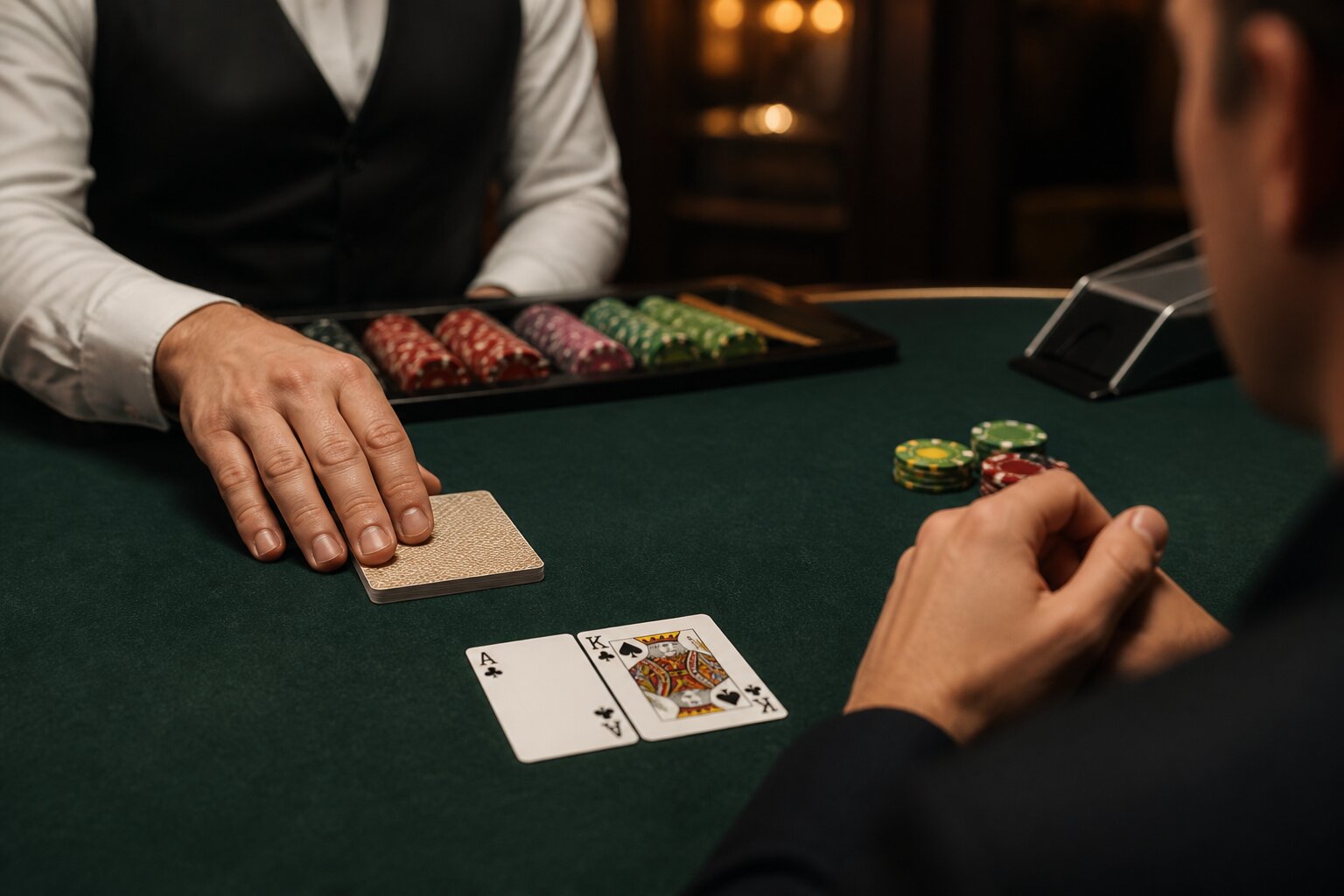
Curious about No Peek Blackjack? You’re not alone. This twist on the classic game keeps the core of blackjack but changes one small rule in a way that alters how each round plays out.
If you want a clear, practical guide to what makes this version different and how to approach a table, this article will walk you through the rules, key differences, common misconceptions, where you might find the game, and sensible tips to play with confidence.
Let’s get started and see why players find this format engaging without losing the clarity you need to make informed decisions.
What Is No Peek Blackjack?
No Peek Blackjack is a variation of traditional blackjack where the dealer does not look at their facedown card until after all players have completed their hands. In most blackjack games the dealer checks that card early if their face-up card is an Ace or a ten-value card, but No Peek removes that early check.
The rest of the game remains familiar. Players receive two face-up cards, the dealer provides one face up and one face down, and players decide whether to hit, stand, double, or split. The absence of the early dealer check makes decisions a little more uncertain, because players must act without knowing whether the dealer holds a natural blackjack.
That single change affects strategy and the flow of a round, so understanding it is key before you play.
How Does No Peek Blackjack Differ From Classic Blackjack?
The defining difference is timing. In classic blackjack the dealer may check their facedown card immediately when their upcard is an Ace or a ten-value card. If the dealer has a blackjack the round ends at that point and bets are resolved. In No Peek Blackjack the dealer waits until every player has finished.
Because the dealer only reveals the hole card at the end of play, any bets placed during the hand, including doubles and split hands, can be lost if the dealer turns over a blackjack later. This makes some aggressive plays riskier than they might be in games where the dealer peeks early.
Besides that, standard rules for hitting, standing, splitting, and doubling remain the same. The change is about when you learn the dealer’s full hand, and that timing shapes choices at the table.
Step-By-Step Guide: How to Play No Peek Blackjack
Begin by placing your bet in the betting area for the round. After bets are placed, two cards are dealt to each player face up, and the dealer receives one card face up and one card face down.
Players then play their hands in turn, choosing to hit to take another card, stand to keep their current total, double to increase the bet and take a single additional card, or split when dealt a pair. Each of these options affects the stake and potential outcome of the hand.
Because the dealer does not check the facedown card at this stage, play continues for all players without knowing whether the dealer has a natural blackjack. Only after every player has completed their actions does the dealer reveal the hole card.
If the dealer turns over a blackjack, any remaining player bets are collected, including those on split and doubled hands. If not, the dealer completes their hand according to house rules and outcomes are settled based on who has the hand value closest to 21 without exceeding it.
When Does the Dealer Reveal Their Hole Card?
In No Peek Blackjack the dealer reveals the facedown card only after every player has finished their turns. This means the entire table acts without knowing whether the dealer has a natural blackjack.
Once the dealer turns over the hole card, it becomes clear whether the dealer has blackjack. If they do, remaining player bets, including those associated with splits and doubles, are lost. If they do not, the dealer proceeds to play their hand according to the established house rules and then outcomes are settled.
This reveal at the end is the feature that defines No Peek Blackjack and explains why players sometimes adjust their choices compared with traditional blackjack.
Common Misconceptions About No Peek Blackjack
One misconception is that No Peek Blackjack is easier to beat than classic blackjack. The rule change alters the distribution of outcomes and the house edge in subtle ways, but it does not make the game easier to win.
Another mistaken belief is that withholding the dealer’s peek hands players an advantage. In practice it increases uncertainty because some defensive plays that protect a stake when the dealer checks early may leave a player exposed here.
Some players think certain betting systems will improve long-term results. In reality, no betting pattern overcomes the game’s rules and the way cards are dealt. Increasing stakes to recover losses is also a risky approach that can magnify losses quickly.
Understanding these points helps set realistic expectations about the game and encourages decisions based on the rules rather than on myths.
Can You Play No Peek Blackjack Online or In UK Casinos?
No Peek Blackjack is less common than standard blackjack and may not appear on every site or casino floor. Some online operators include it among alternate variants, while bricks and mortar casinos tend to offer more traditional tables.
If you plan to play online, check that the operator is properly licensed and that the game’s rules are clearly stated. In the UK, chosen operators should meet regulatory requirements and you must be of legal age to play. Rules and availability can change, so it is worth checking the current game list where you play.
If you prefer land-based play, ask the casino staff or check the table listings for variant names and specific house rules before you sit down.
Essential Tips for Playing No Peek Blackjack Responsibly
Deciding a bankroll before you sit at a table helps you set clear limits on what you can afford to spend. Breaks between sessions are useful for keeping perspective, and using account or casino tools such as deposit limits and session reminders supports controlled play.
Because the dealer reveals the hole card only at the end, be mindful that doubles and splits carry the additional risk of being lost if the dealer later shows blackjack. That context can guide more cautious staking decisions.
If gambling ever begins to feel difficult to manage, confidential support is available from specialist organisations. Keeping play enjoyable and within your means ensures No Peek Blackjack remains an entertaining game.
Frequently Asked Questions About No Peek Blackjack
Here are answers to some of the questions players most often ask, presented clearly so you have the facts when you need them.
Is No Peek Blackjack legal in the UK?
Yes. Playing No Peek Blackjack is legal in the UK provided you play with an authorised operator and meet the legal age requirement.
Does the dealer ever check for blackjack before players finish?
No. The dealer only checks the facedown card after all players have completed their hands.
Does No Peek Blackjack have different rules for hitting or standing?
The fundamental options for hitting, standing, splitting, or doubling are generally the same as in standard blackjack. The key difference is the timing of when the dealer’s hole card is revealed.
Can you use a betting system to improve your chances in No Peek Blackjack?
No betting system can guarantee success. It is wiser to set limits, manage your bankroll, and treat play as entertainment.
Where can I get help if I’m worried about my gambling?
If you are concerned about your gambling, confidential support and advice are available from organisations such as BeGambleAware and GamCare.
Final note: No Peek Blackjack turns a familiar game into something a little more tense and strategic by changing one simple timing rule. Understanding that rule, and how it affects stakes and decisions, is the best way to enjoy the game responsibly.
**The information provided in this blog is intended for educational purposes and should not be construed as betting advice or a guarantee of success. Always gamble responsibly.