
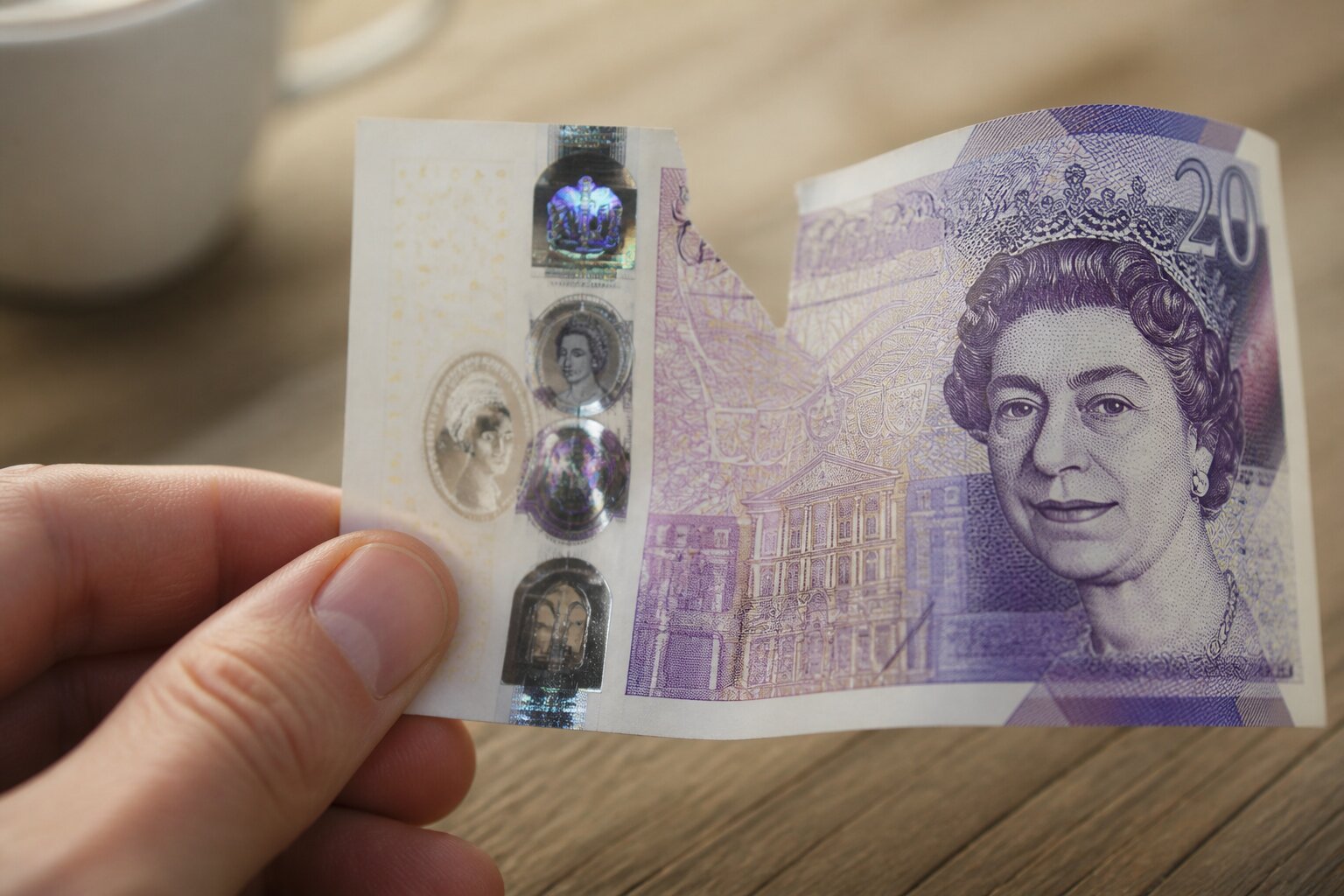
Ever pulled out your wallet to pay, only to discover your note’s got a tear down the middle? It’s a common panic moment, and you’re not alone in wondering what to do next.
Will the shop take it? Is it even legal to use? Read on for clear answers, practical options and simple tips to avoid getting caught out next time you’re making a purchase.
Understanding Banknote Damage: What Counts as a Ripped Note?
A ‘ripped note’ in the UK means a banknote that’s physically damaged so it no longer looks complete or is difficult to use in transactions. Common forms of damage include tears, missing pieces, holes, heavy wear or notes that have been taped back together. Even a small corner missing or a note with marks can affect whether it will be accepted.
Minor damage — a small nick or light wear — will often leave a note usable, provided security features and serial numbers remain clear. Larger tears, missing sections or notes split through the centre are more problematic because they can obscure key features that retailers or cash machines need to check. Notes that have been heavily taped are also likely to be rejected, since the repair can interfere with authentication.
If a note is missing a segment but still shows the serial numbers and other security markers, it may be eligible for exchange at a bank. When vital parts such as both serial numbers or the polymer window are gone, the note may be treated as void. Next, we’ll look at how legal tender rules relate to this practical picture of damaged notes, and what that means for everyday transactions.
Legal Tender Rules for Damaged Notes in the UK
Legal tender is a technical term meaning money that can be used to settle a debt, but it does not force shops to accept any particular note in day-to-day sales. In practice, retailers can set their own policies on which notes they will accept. This means a note can be technically valid yet still be refused at the till if a shop chooses.
The Bank of England guidance explains that if more than half of a banknote remains and serial numbers and security features are present, banks will generally exchange it. That service is provided by banks and by the Bank of England’s Mutilated Notes Service for more severely damaged notes; retailers are not required to offer exchanges.
If a note is refused in a shop, there is still a route to recover its value through bank exchange or, for badly damaged items, a claim with the Bank of England. The next section explains how individual retailers assess damaged notes and what staff look for when deciding whether to accept them.
How Retailers Decide Whether to Accept Ripped Notes
Retailers exercise discretion when accepting cash and focus on whether they can reliably verify a note’s authenticity and value. Staff will usually check that security features such as holograms, see-through windows and serial numbers are intact and that the denomination is clearly identifiable. If these checks are possible, minor tears are more likely to be accepted.
Notes that are missing large parts, have been extensively repaired or are badly defaced tend to be refused because they are harder to authenticate and may increase the risk of fraud. Self-service tills and vending machines rely on intact features and are therefore much less forgiving than a human cashier.
Large businesses often enforce stricter guidelines, training employees to decline notes that are torn through crucial areas; smaller shops may make case-by-case judgements. Where a retailer declines a note, staff should explain the reason and, where appropriate, direct customers to a bank for an exchange. If a shop won’t take a note, you still have practical options to resolve the situation, which are outlined next.
What Happens If Your Note Is Refused?
If a business refuses a ripped note, it is within its rights to do so, and that may leave you unable to complete a purchase if no alternative payment is available. Handling the situation calmly and knowing your options helps avoid unnecessary inconvenience.
You have a few realistic choices when a note is declined. First, you might try another retailer; some businesses accept notes with only minor damage. Second, you can take the note to your bank where staff will assess it against Bank of England guidelines. If the damage is too severe for a routine exchange, an application to the Bank of England’s Mutilated Notes Service is the next option.
Options If a Shop Won’t Accept Your Note
There are a couple of practical routes to recover the value of a note that’s been refused at the till.
- Use it at another retailer: Some businesses may accept notes with only minor damage, though acceptance is never guaranteed.
- Exchange it at your bank: Most banks will accept damaged notes for exchange if more than half the note remains, serial numbers are intact and security features are visible. Banks may exchange the note over the counter or arrange to credit your account.
If a bank cannot accept the note directly, an application to the Bank of England’s Mutilated Notes Service allows you to submit the damaged material for assessment and possible reimbursement. The bank or the Bank of England will explain what documentation or details are required for that process.
Can You Exchange Ripped Notes at a Bank?
Banks normally follow Bank of England rules when assessing damaged notes. For a straightforward exchange, they usually need to see that at least 50% of the note remains and that serial numbers and security features can be verified. When these conditions are met, the bank can often replace the note or deposit its value.
For notes with larger sections missing, or where the damage makes authentication difficult, the Bank of England’s Mutilated Notes Service is the proper route. That service asks for an explanation of how the note became damaged and for you to submit the remains; each case is assessed individually and, where the claim meets the criteria, reimbursement is made.
Now that you know where to take a damaged note, a few practical habits can help you avoid the problem in the first place.
Tips for Handling Damaged Banknotes
A little care goes a long way in keeping notes in a usable condition. Store banknotes flat rather than folded repeatedly, keep them dry and away from heat or liquids, and avoid writing on them or applying tape. When receiving change, check notes before you leave the till and keep the receipt if the note looks questionable; that can help if you need to return to the shop.
If you discover a tear, don’t attempt to repair the note with household tape or glue, since such repairs can hinder authentication and lead to refusal. Instead, set the note aside and visit your bank or, if necessary, use the Bank of England’s Mutilated Notes Service.
Simple habits like these reduce the chance of being unable to pay with cash and make it easier to resolve any issues that do arise. With that in mind, here’s a concise summary of what to remember.
The Bottom Line: Handling Ripped Notes in Everyday Transactions
Retailers may refuse ripped or damaged notes because they need to be confident about authenticity and value. While Bank of England guidance allows for replacement of notes when sufficient material and security features remain, acceptance at the till is always at the retailer’s discretion. If a note is refused, try another retailer only for minor damage, or take the note to your bank for assessment; severely damaged notes can be submitted to the Bank of England for evaluation and possible reimbursement.
By checking and handling notes carefully, and knowing the exchange options available, you can avoid most problems and resolve the rest without too much fuss. This approach keeps everyday transactions straightforward and predictable.
**The information provided in this blog is intended for educational purposes and should not be construed as betting advice or a guarantee of success. Always gamble responsibly.