
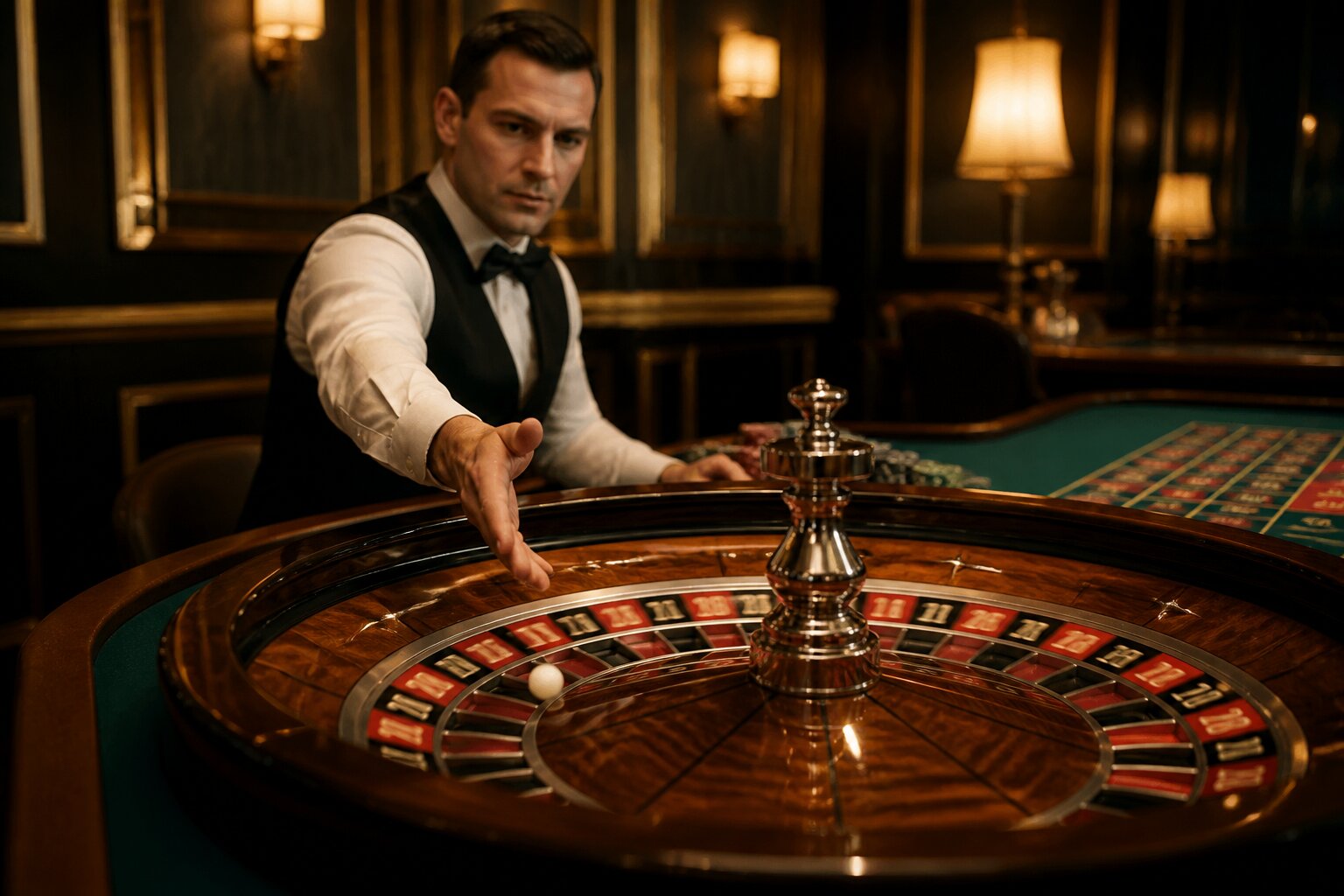
Have you ever watched the little white ball spinning round a roulette wheel and wondered if the dealer had a hidden trick up their sleeve? It’s a question that crops up as the wheel slows and the atmosphere tightens — an image of a skilled croupier nudging the outcome to their advantage is hard to shake.
Roulette is one of the most recognisable games in any UK casino, and with significant sums at stake on some spins, curiosity about the dealer’s role is natural. This article looks at how the wheel works, what dealers actually do, the science behind the action, and whether any of the common rumours stand up to scrutiny.
Read on to separate myth from fact and to understand why the outcome of each spin is governed by equipment, procedure and physics rather than by a single person at the table.
How Does a Roulette Wheel Work?
A roulette wheel is precision equipment built to produce a random result on each spin. The wheel sits in a sloped bowl and contains numbered pockets that alternate between red and black, with a green zero on European-style wheels. The dealer spins the wheel one way and rolls the ball the opposite way along the rim. As the ball slows it hops across small metal frets and finally drops into a numbered pocket.
What determines where the ball lands is a mix of physical factors: the wheel’s rotational speed, the ball’s initial speed and angle, friction between surfaces, the profile of the frets, and tiny variations in the pocket lips. Each spin happens quickly and under many small influences, so even very similar launches can produce different results.
Casinos maintain wheels to strict mechanical standards and test equipment regularly to ensure pockets, diamonds and frets remain within tolerances. That mechanical upkeep, together with consistent dealing procedures, is part of what keeps the game fair and makes each spin unpredictable. The next section explains the dealer’s actual role at the table and why their tasks are about managing the game rather than influencing outcomes.
The Role of the Dealer: Fact or Fiction?
The dealer, or croupier, has a clearly defined set of duties: spinning the wheel, launching the ball, taking bets, calling “no more bets” and settling wins and losses. Their training focuses on consistency, speed and accuracy so the game runs smoothly and players understand what’s happening.
Despite persistent rumours, a croupier does not have a method for steering the ball to a chosen pocket. Procedures are in place that standardise how the wheel and ball are handled, and supervisors monitor activity to ensure those procedures are followed. The dealer’s work is about officiating the game rather than altering its result.
Because dealers repeat the same motions many times, some players notice patterns in their style and assume those motions could affect outcomes. In reality, those personal habits are swamped by the physical randomness of the spin; the dealer’s consistent technique helps keep play orderly, but it does not make the game more predictable. In the next part we’ll look at the specific techniques that rumours focus on and whether there’s any substance to them.
What Techniques Are Dealers Rumoured to Use?
Stories around the roulette table include ideas such as “dealer signature”, “section shooting” and “controlled spins.” These suggest that a dealer might develop a repeatable spin that favours a particular region of the wheel, or that a skilled croupier can anchor the ball to land in a narrow set of pockets.
Those rumours arise because humans like to spot patterns, and dealers do develop distinctive routines. However, the claims rely on the notion that small, repeatable differences in a croupier’s motion could overcome all the other variables acting on the ball, which is not supported by careful analysis.
The next two short subsections examine whether any of these ideas can stand up to scrutiny and what evidence, if any, has been found.
Can Dealers Intentionally Influence the Outcome?
There is no reliable evidence that modern, regulated dealers can control where the ball lands. Casinos have clear routines for spinning and launching that remove personal improvisation, and surveillance keeps action under continuous review. Where apparent runs of similar results occur, they are far more plausibly explained by random clustering than by deliberate interference.
Is There Any Evidence Behind Skill or Bias?
Independent tests and industry reviews have not demonstrated that a dealer can create a repeatable, exploitable pattern in properly maintained wheel systems. Wheel bias—where mechanical wear makes some pockets more likely than others—has been recorded historically, but rigorous maintenance and audits make such faults rare today. Therefore, claims of dealer skill producing predictable outcomes lack solid backing in modern regulated settings.
With those myths addressed, it helps to understand the physics that underlie every spin and why small variations dominate any repeatable human action.
Do Casino Rules Prevent Dealer Influence?
Casinos operate procedures designed to prevent any party from affecting outcomes. Dealers are trained to follow those routines closely, and supervisors watch table activity in person and via CCTV. Equipment is tested by technicians and independently audited on a scheduled basis to spot any irregularities.
Staff undergo background checks and ongoing training so they remain accountable and competent, and any deviation from standard practice is quickly investigated. Those controls make manipulation by a dealer extremely unlikely, and they protect the integrity of the game for everyone involved.
The next section explores the role that physics plays in producing the final result of a spin and why technical measures complement procedural safeguards.
The Science Behind Ball and Wheel Physics
Roulette outcomes are the product of complex, short-duration physical interactions. The ball’s initial speed and launch angle, the rotational speed of the wheel, subtle variations in the surface finishes, the geometry of the frets and pockets, and tiny environmental factors all combine to determine where the ball will settle.
Because so many variables interact over the course of a few seconds, even highly repeatable human actions get overwhelmed by small, unpredictable differences. Think of it as a cascade of micro-events: each collision with a fret or pocket lip changes the ball’s motion in ways that are effectively impossible to predict in advance.
To counter historical issues such as wear-induced bias, casinos schedule maintenance and replace worn parts. Surveillance and independent spot checks allow operators and auditors to detect any anomalies quickly. Together, this scientific understanding and technical upkeep mean that equipment behaves as intended and that outcomes remain governed by the many physical variables at play.
With the mechanical and human factors covered, it’s useful to return to the most persistent claim about dealers and examine whether “dealer signature” is a meaningful concept today.
Is Dealer Signature a Real Phenomenon?
“dealer signature” is the idea that a croupier’s personal spin style creates a recognisable pattern that can be exploited. In practice, while dealers can be consistent in their technique, the surrounding physical factors make repeatability of final outcomes highly unlikely.
Testing and analysis have shown that any apparent repeatability is usually the result of short-term clustering — a natural occurrence when many independent events are observed — rather than a true, lasting pattern. Modern operational standards, equipment maintenance and monitoring reduce the chance that a dealer’s style could produce a reliable signature even further.
Understanding this helps set realistic expectations at the table: dealer routines help the game flow and maintain fairness, but they do not provide a hidden mechanism for directing the ball.
Roulette draws attention because the final moment of a spin is dramatic and uncertain, but that uncertainty stems from equipment, procedure and physics, not from a single individual’s actions. This provides reassurance that when the ball finally drops, the outcome reflects the careful design and oversight built into the game.
Explore Casino Games at Slots Racer
We would love for you to become part of our community of players at Slots Racer, where entertainment and enjoyment bring us all together. Discover the fun that comes from playing with others who share your passion for casino games.
Getting started is simple: just create an account, make a deposit and you can begin exploring everything we have to offer. We look forward to welcoming you.
**The information provided in this blog is intended for educational purposes and should not be construed as betting advice or a guarantee of success. Always gamble responsibly.