
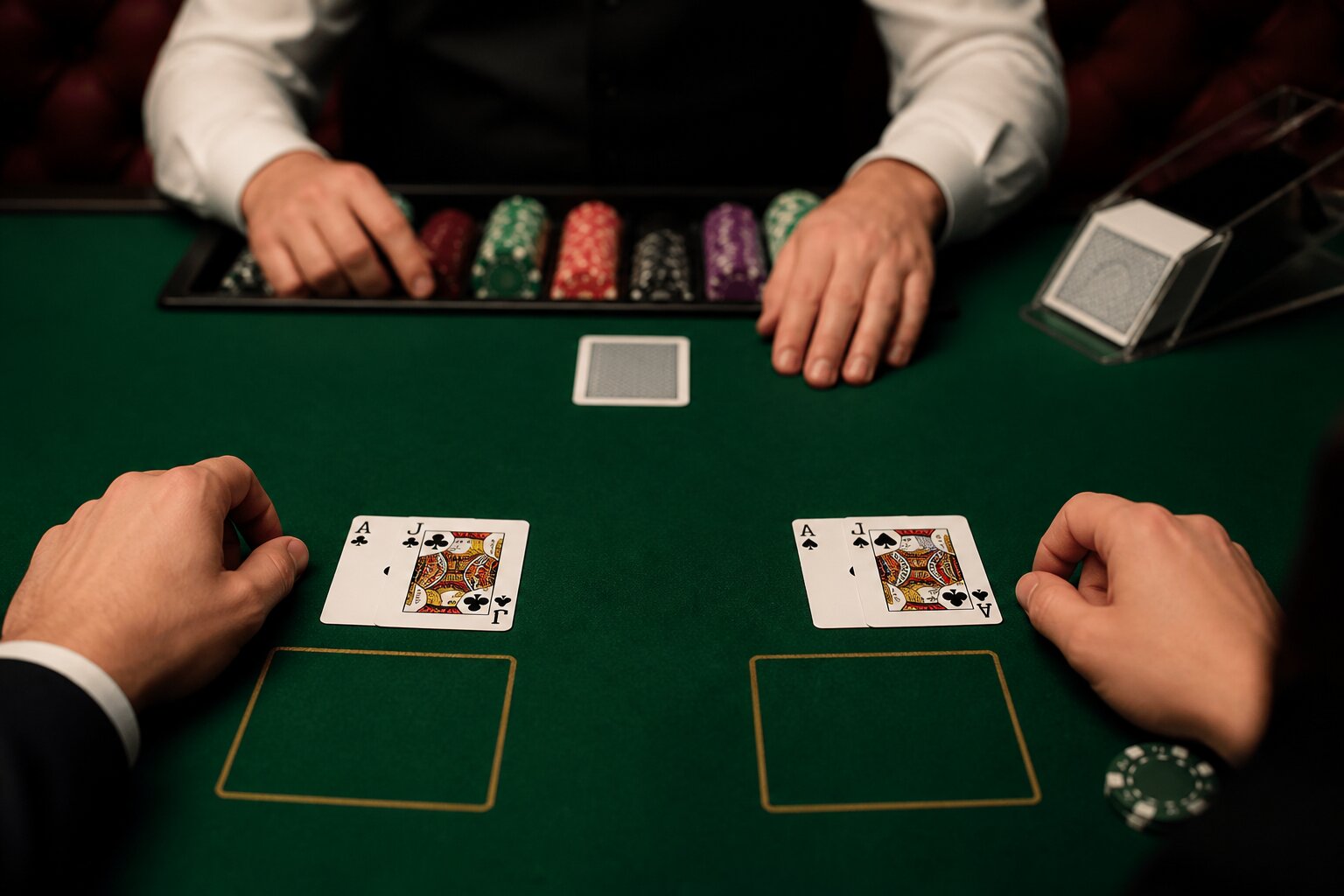
Picture the buzz around a busy blackjack table. The cards are flying, the stakes are high, and suddenly, two players hit that perfect 21. You can almost feel the collective intake of breath—is it cheers all round or does someone miss out?
It’s one of those moments when excitement mixes with confusion. If both players hit the same number, does it mean they both win, or is there more to the story? Understanding how the game treats different kinds of 21 clears up that uncertainty and helps you know what to expect from the dealer’s response and the table’s payouts.
Below, the rules and outcomes are explained in detail so you can see exactly how identical totals are settled and why the way a 21 is made matters. Read on to learn how the dealer’s hand determines each result and what that means for split hands and ties.
Understanding the Basics of 21 in Blackjack
Scoring 21 is the primary objective for most players, but not all 21s are treated the same. A two-card combination consisting of an Ace and any 10-value card (10, Jack, Queen or King) is called a “blackjack” or “natural” and is the strongest possible initial hand.
You can also reach 21 with three or more cards. Hands such as 7-7-7 or 9-2-J add up to 21 but are not classified as blackjack. Those hands still beat most dealer totals, yet they are compared and paid differently from a natural blackjack.
This distinction affects both the result against the dealer and the payout received. Keep an eye on how your 21 was formed, because that detail often decides whether you receive the higher blackjack payout or standard winnings. Next, we’ll look at what happens when multiple players achieve 21 in the same round.
What Happens When More Than One Player Gets 21?
Every player at the table plays individually against the dealer, so several people can have the same total and still receive different results. If two or more players reach 21 in the same round, each hand is resolved separately by comparing it to the dealer’s final hand.
If the dealer finishes with a total below 21, all players holding 21 win their hands and are paid according to how their 21s were formed. If the dealer has 21 as well, outcomes depend on whether those 21s are naturals or totals made with more cards. The dealer’s combination can override non-natural 21s even when totals match.
This individual settlement means it’s possible for several players to win, draw or lose in the same deal, depending on the dealer’s cards. That distinction between player-versus-dealer settlement leads directly into how comparisons are made round by round.
Comparing Player Hands to the Dealer
Each hand is judged only against the dealer’s completed total, not against other players’ hands. A player with 21 will beat a dealer total lower than 21, push if the dealer has an equivalent hand under the same classification (for example, both have a blackjack), or lose if the dealer has a superior form of 21—such as a natural blackjack outranking a multi-card 21.
To illustrate: if two players both hold 21 and the dealer has 19, both players win. If the dealer has a blackjack, any player with a natural blackjack will push, while players whose 21 came from more than two cards will lose. The way hands are compared emphasises why the composition of the total matters as much as the number itself.
With that settled, the next section explains how those outcomes translate into payouts.
Payouts and Results When Multiple Players Get 21
Payouts depend on whether a 21 is a natural blackjack or a standard 21. A natural blackjack typically pays at the higher rate (commonly 3:2), meaning a winning £10 stake returns £25 total (£10 stake + £15 winnings). A 21 made with more than two cards pays at even money (1:1), so a £10 stake returns £20 total (£10 stake + £10 winnings) when the dealer’s hand is beaten.
When multiple players have 21 and the dealer does not, each qualifying player is paid independently according to their hand type. If the dealer also has 21, naturals usually result in a push and multi-card 21s typically lose to a dealer blackjack. House rules can vary slightly about exact payout rates and some edge cases, so it’s sensible to check the table rules before play.
While the main payout differences are clear, there are special situations—such as split hands and how they are treated—that deserve their own explanation next.
Special Rules for Blackjack vs. 21
Some hands are granted different status simply because of how they were dealt. Below is a short guide to the key distinctions and how they affect outcomes.
What counts as a ‘Blackjack’?
A ‘blackjack’ is a first-two-card hand of an Ace plus any 10-value card. This is the premium initial result and is paid at the higher blackjack rate when it wins.
Is 21 always treated the same as blackjack?
No. Any 21 formed with three or more cards is treated as a standard winning total rather than a blackjack. That difference affects both payouts and how ties with the dealer are settled.
Examples of non-blackjack 21s include hands like 7-7-7 or 9-2-J. These still compete well against the dealer, but they do not qualify for the blackjack payout and can lose if the dealer holds a natural blackjack. With these rules understood, we can consider how split hands are handled, which often raises extra questions at the table.
What Counts as a ‘Blackjack’?
A blackjack occurs when the first two cards are an Ace and any 10-value card. This combination is treated as a single, superior outcome for settlement and payout.
Is 21 Always Treated the Same as Blackjack?
A 21 made with more than two cards is a standard 21, not a blackjack. That distinction affects both the payout received and whether the hand pushes or loses against a dealer blackjack.
Implications for Split Hands and Multiple Players
Splitting creates separate hands that are each compared to the dealer in turn. If a split hand reaches 21, it is judged like any other 21: the composition matters. For instance, splitting Aces and receiving a 10 on each split hand usually results in two hands that total 21 but are not treated as blackjacks; payouts for those hands are generally at even money rather than the blackjack rate.
When many players and split hands reach 21 in the same round, each result is settled independently against the dealer. That keeps outcomes fair and predictable, and it helps explain why identical numbers at the table can still lead to different financial results. Next, we’ll look at what happens when the dealer matches a player’s 21.
Does the Dealer Tie Affect the Outcome?
A tie with the dealer is typically resolved as a push, returning the player’s original stake, but the classification of the tied hands is crucial. Two-card naturals tied with each other result in a push, whereas a dealer blackjack will beat any player 21 that was formed with more than two cards.
If both dealer and player have 21 formed with three or more cards, this is usually a push and the stake is returned. House rules can vary on some edge cases, but the overall principle is consistent: the dealer’s combination and the player’s hand type together determine whether a tie returns money, wins, or loses.
Understanding these settlement rules helps clarify why identical totals across the table don’t always produce identical outcomes. With these points in mind, you can sit at the table with a clearer sense of how each hand will be treated and what to expect when the dealer reveals their cards.
Play Casino Games Online at Slots Racer
We invite you to enjoy our range of casino games in a welcoming and easy-going setting. At Slots Racer, everyone is welcome to come along for a bit of online entertainment at their own pace.
Getting started is straightforward: simply create an account with us, make your deposit and you are ready to play. We look forward to seeing you at Slots Racer.
**The information provided in this blog is intended for educational purposes and should not be construed as betting advice or a guarantee of success. Always gamble responsibly.